WHO Guidelines Explained: 150 Minutes a Week and 2 Days of Strength
The WHO recommends 150-300 minutes of moderate activity weekly plus two days of strength training. What the guidelines actually say and how to meet them.

Studies link push-up capacity to heart health and show push-ups can match bench press for hypertrophy. Where bodyweight training stands.
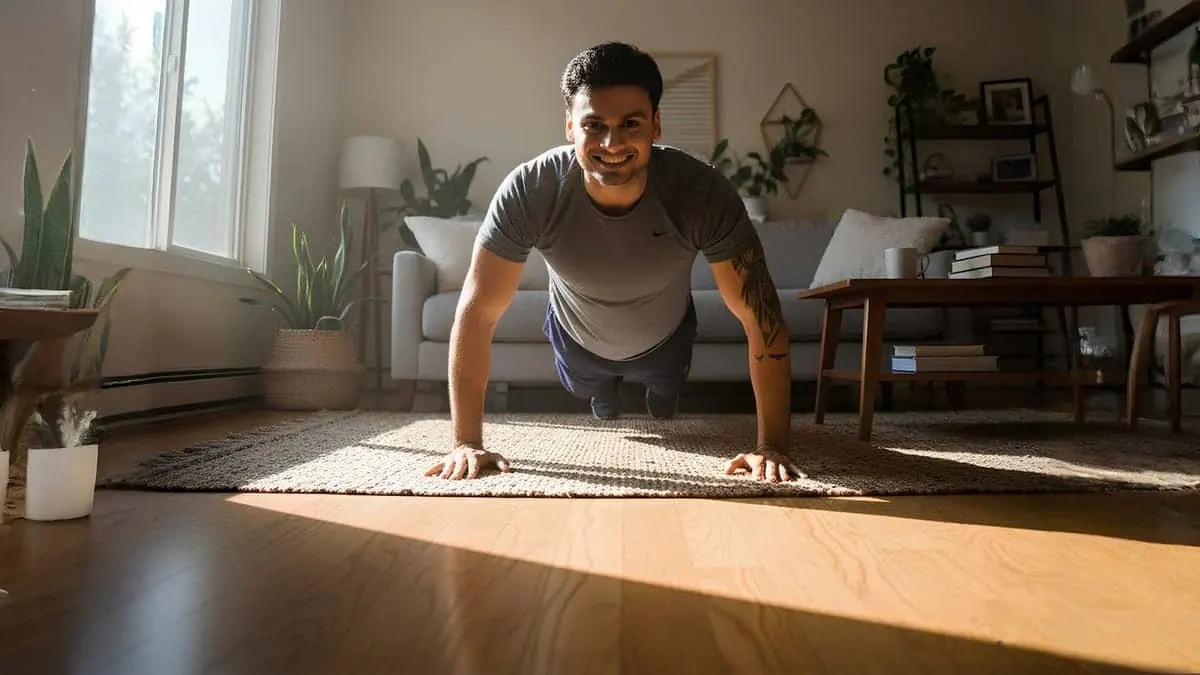
The useful question about home training is not whether body weight counts as resistance. It is whether an exercise can challenge the intended muscles and still become harder as capacity changes. Push-up training trials address part of that question directly; the often-cited firefighter study addresses a different one, using push-up capacity as a health marker. Keeping intervention results separate from a screening association avoids turning a striking cardiovascular percentage into a promise that doing more push-ups will prevent disease.
For an editorial planning example, write down the push-up variation, support height, repetitions and how the last repetition felt. If a variation becomes easy, change one variable rather than changing the whole routine. Equally, establish when another tool becomes sensible: a stable pulling setup or added load may solve a problem that increasingly elaborate bodyweight variations do not. The progression ladder should include an easier option for a difficult day. Its purpose is consistent observation of a training task, not reproducing the firefighter test or using that score to estimate personal cardiovascular risk.
In 2019, researchers led by Justin Yang at the Harvard T.H. Chan School of Public Health published a 10-year cohort study in JAMA Network Open. They followed 1,104 male firefighters in Indiana, average age about 40, who performed a metronome-paced push-up test at baseline and were tracked for cardiovascular events over a decade, during which 37 events occurred.
The result was dramatic. Men who could complete more than 40 push-ups had a 96 percent lower rate of cardiovascular disease events than men who managed fewer than 10 — an incidence-rate ratio of 0.04. Push-up capacity was more strongly associated with outcomes than the submaximal treadmill test the same men completed, which surprised the authors.
The caveats are printed in the same paper: the cohort was entirely male, occupationally active and relatively fit, and the design was observational. Push-up capacity is a marker of overall fitness, not a demonstrated cause of protection, and the finding cannot simply be extended to women or sedentary populations.
The hypertrophy question got its cleanest test in 2017, when Kikuchi and Nakazato in Japan randomized 18 trained men to bench-press training or push-up training twice a week for eight weeks. The push-up group adjusted position — kneeling variations where needed — so the load matched roughly 40 percent of each lifter's bench-press maximum, and both groups trained close to failure.
By ultrasound measurement, increases in pectoralis major and triceps thickness were similar between groups, and both improved one-repetition-maximum bench press comparably. The single exception was biceps thickness, which grew only in the bench-press group — a reminder that pressing does not train pulling muscles, and a home program needs rows or pull-ups to fill the gap.
A follow-up trial in 2018 by Kotarsky and colleagues tested progressive calisthenics directly: 23 moderately trained men trained three times a week for four weeks, one group on escalating push-up variations, the other on bench press with added load. Both groups gained bench-press strength with no significant difference between them, and the push-up group improved substantially more on the push-up test itself.
The shared principle is overload. Bodyweight training works when the exercise is hard enough for the target muscle and keeps getting harder — through leverage changes, harder variations, added reps, tempo or load — exactly as the progressive-overload literature prescribes. Thirty effortless push-ups are conditioning; eight grinding ones are a stimulus.
Honesty requires the gaps. Building maximal lower-body strength is hard without load: single-leg squats and hip hinges help, but external weight remains the most convenient way to keep legs progressing. Pulling demands equipment, even if only a sturdy bar or a table for rows. And for lifters chasing very high strength levels, barbells make progressive loading simpler than endless variations do.
Reading the trials side by side reveals a template worth copying. Sessions were short — the Kotarsky protocol fit comfortably into half an hour, three days a week — but every working set was taken close to failure, which is where bodyweight training either earns or loses its stimulus. Exercises were chosen so the target muscle was genuinely challenged: participants who could not make standard push-ups hard enough progressed through harder foot positions, pauses and slower tempo rather than piling up effortless repetitions.
That is the practical translation for home training. Pick variations that make eight to fifteen repetitions genuinely difficult — incline push-ups to begin, decline or slow-tempo versions as strength grows — and log the numbers every session so progression is visible rather than guessed. Pair pressing with pulling, add a squat or hinge pattern for the legs, and treat the whole thing as a program with progression rules rather than a random collection of exercises. The research does not claim bodyweight training is magic; it shows that when effort and progression are controlled, muscle does not particularly care where the resistance comes from.
The verdict from the studies is neither hype nor dismissal. Bodyweight training measurably builds muscle and strength, and a simple field test of it tracks long-term cardiovascular health — but only when it is programmed with the same seriousness as iron.
The WHO recommends 150-300 minutes of moderate activity weekly plus two days of strength training. What the guidelines actually say and how to meet them.
Use the two-day strength guideline to plan muscle-group coverage and repeatable sessions, without treating mortality curves as a precise training dose.

Cohort studies tracking thousands of adults found mortality benefits around 7,000-8,000 daily steps, not 10,000. What the numbers actually show.