WHO Guidelines Explained: 150 Minutes a Week and 2 Days of Strength
The WHO recommends 150-300 minutes of moderate activity weekly plus two days of strength training. What the guidelines actually say and how to meet them.
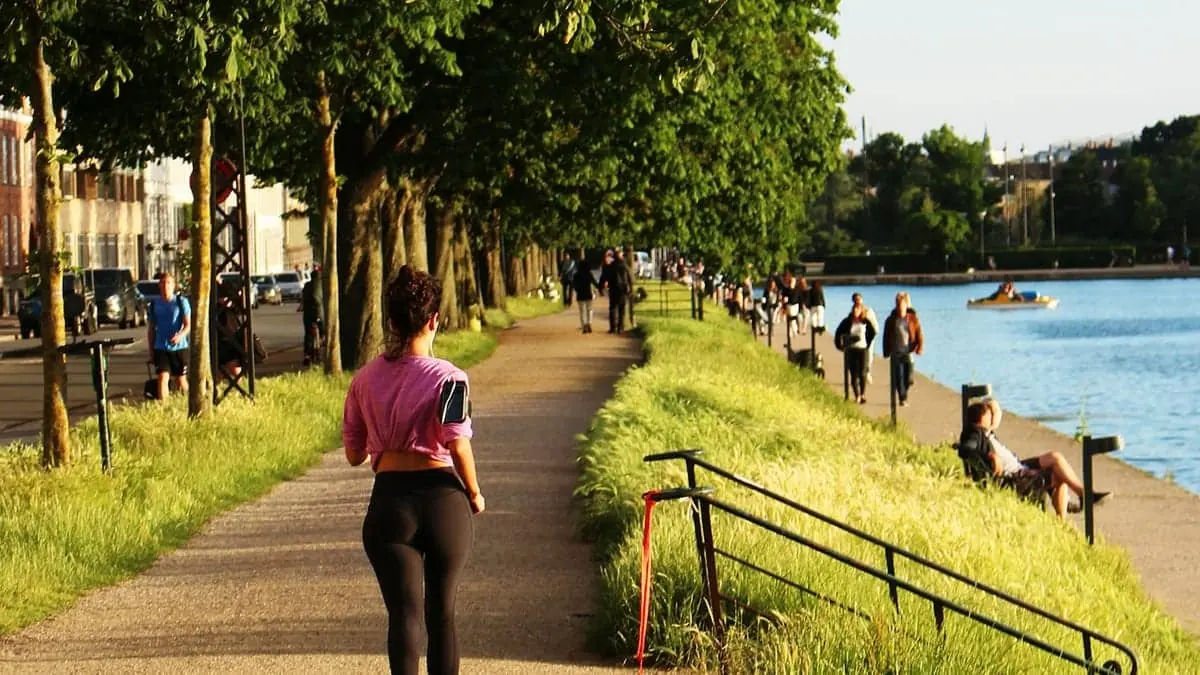
Cohort studies tracking thousands of adults found mortality benefits around 7,000-8,000 daily steps, not 10,000. What the numbers actually show.

A step target is more useful when it starts with the number a person already walks. The observational studies discussed here suggest that risk differences are substantial between low and higher step counts, with age-related variation in where curves flatten. They do not establish a single threshold everyone must cross or prove the effect of prescribing a particular extra walk. This article focuses on reading the dose-response curve and translating it into a manageable habit without treating 10,000 steps as a universal medical instruction.
Use several ordinary days to describe baseline rather than choosing an unusually active day. Keep the device and wearing position consistent when watching the trend, and note days when it was not worn. An added walk to a regular destination can be easier to repeat than a late-night effort to clear a round number. That is a planning example, not a proven dose for an individual. A plateau in a mortality association does not mean additional walking has no other value, while a low-count day does not erase the pattern of the preceding month.
In 2020, Saint-Maurice and colleagues published a study in JAMA that followed 4,840 American adults aged 40 and older from the NHANES survey, a nationally representative sample. Participants wore research-grade accelerometers for about a week between 2003 and 2006, then were tracked through the National Death Index for a median of roughly 10 years, during which 1,165 deaths occurred.
Compared with people averaging 4,000 steps a day, those taking 8,000 steps had a 51 percent lower risk of all-cause mortality, and those taking 12,000 steps had a 65 percent lower risk. The benefit appeared across men and women and across age and ethnic subgroups. One surprise: after accounting for total step volume, the intensity of stepping showed no significant association with mortality in this cohort, meaning how fast you walked mattered less than how much.
Because the NHANES cohort was middle-aged and older, researchers wondered whether the same thresholds applied to adults in their forties. In 2021, Paluch and colleagues examined the CARDIA cohort in JAMA Network Open — 2,110 adults with an average age around 45, followed for more than a decade with wearable step tracking.
The dividing line that emerged was 7,000 steps. Participants who averaged at least 7,000 steps a day had a substantially lower risk of dying during follow-up than those below it — on the order of 50 to 70 percent lower, depending on how far above the threshold they walked. Above 7,000, additional steps were associated with little further decline in risk. For a generation raised on five-digit goals, the finding reframed success: the jump from 4,000 to 7,000 steps carried most of the reward.
The clearest synthesis arrived in 2022, when the Steps for Health Collaborative led by Paluch pooled 15 international cohorts totaling 47,471 adults in The Lancet Public Health. The dose-response curve rose steeply from sedentary levels and then plateaued: around 6,000 to 8,000 steps per day for older adults, and around 8,000 to 10,000 for adults under 60, beyond which mortality risk stopped falling meaningfully.
Two details deserve emphasis. First, the curve never turned upward — no analysis found harm at high step counts, only diminishing returns. Second, the steepest part of the slope sat at the bottom. Moving from 2,000 to 4,000 steps was associated with a larger relative benefit than moving from 9,000 to 11,000, which is precisely why the research matters for public health rather than for step-count competitions.
The flattening makes physiological sense. Early steps recruit large muscle mass, improve insulin sensitivity and raise cardiovascular demand from a low baseline, so each incremental step does a lot of work. Once someone is already moderately active, the same step adds less new stimulus. Epidemiologically, there is also the familiar caveat that observational cohorts cannot fully separate walking from the people doing it: heavier walkers tend to be younger, leaner and healthier at baseline, even though the studies adjusted for these factors.
Correlation is not causation, and no trial has randomly assigned lifelong step counts. Still, the consistency across independent cohorts using different devices, countries and follow-up periods gives the pattern unusual credibility for observational research.
The practical translation is easier than the goal sounds, because steps accumulate in fragments rather than workouts. A ten-minute walk covers roughly a thousand steps; parking farther away, taking stairs, pacing during phone calls and a short post-meal loop each add hundreds more without any scheduling. People who currently sit most of the day should treat the first added thousand steps as the headline result, not the ones still missing from a round-number target. Wearable counts also vary from research accelerometers by several percent depending on the device and where it is worn, so the exact figure matters less than the week-over-week trend. And because the benefit plateaus rather than vanishes, walkers who already clear eight or ten thousand steps have little reason to overhaul their routine — the data suggest their returns have largely been banked.
The 10,000-step goal will survive because it is round and memorable. The evidence says something kinder: most of the mortality benefit of walking is already yours by the time the seventh or eighth thousand step lands.
The WHO recommends 150-300 minutes of moderate activity weekly plus two days of strength training. What the guidelines actually say and how to meet them.
Use the two-day strength guideline to plan muscle-group coverage and repeatable sessions, without treating mortality curves as a precise training dose.

Compare interval and continuous training by fitness gains, recovery demands and available time, with the units in the 2015 research explained.